Showing posts with label Is this a good time to buy a house?. Show all posts

Tuesday, February 25, 2014

Is it a good idea to buy a new construction home?

Five reasons to buy a new build home

Like most of the real estate industry, there’s been major growth in new home construction. Here are five reasons to consider building a brand new home.

  • Design your dream home 
    • When you’re in on the home building process from the very start, you get to pick the floor plan that ‘s perfect for you and your family. It’s the best way to get the exact home you want.
  • Save on energy costs
    • While older homes can have inefficient heating, cooling, insulation, and appliances, new homes are typically built for energy efficiency from the very start. Your utility bills could be dramatically lower.
  • Community amenities
    • If your new home is part of a planned community, you can take advantage of amenities like swimming pools, fitness centers, and other recreation areas that might not be available otherwise.
  • Fewer worries, fewer surprises
    • With a new build, it’s less likely that you’ll run into maintenance and repair issues compared to what you might experience with an existing home.
  • Enjoy it from the start
    • No need to endure the frustration that might come with a fixer-upper. With a new home, you can enjoy your new space the day you move in.
Click HERE to read more about New Construction homes?

Looking for reasons to think twice before choosing to build a brand new home? 

Want to search for new homes? Visit this LINK to search.

Here are some additional Tips for Buying New Construction.

Thursday, November 7, 2013

Smart Homebuyers Are Locking In Ultra Low Rates Before The Fed Hike

Are you a smart home buyer?
By +Sarah Marrinan - Keller Williams Premier Realty 
The recent mini spike in mortgage rates has homeowners scrambling to save thousands over the next several years by locking in a rate today. Many homeowners are just now recuperating from seeing their home values plummet in the past, to finally seeing positive equity, so now is the time to take advantage of low-rate mortgages before rates begin climbing higher.
The Fed lowered short term rates several years ago to near zero in an effort to revive the economy. Now that we are seeing a recovery it's expected we will begin to see rates escalate to normal levels. Historically, rates on 30 year loans are usually between 5.50%-7.25% and higher. Below is the difference on a $200,000 mortgage for a 30 year term at an available rate today of 3.25% vs 6.75%.
 Search for homes now!

Sunday, September 29, 2013

What is more important? Credit Score or Down Payment?

So, is your credit score more important or the size of your down payment when it comes to getting a mortgage on a house?  

Let's take a look. You down payment determines your Loan to Value ratio.  Your LTV and credit score are primary factors in determining your mortgage qualification and the rate your will receive.

To demonstrate how Loan To Value and credit score impact APR, consider these three buyer profile scenarios.
  • Jenny has managed to save up a sizable down payment of 30% on her dream home, but she has always paid for everything in cash and has no credit history so her credit score is only 635.  
  • Amy has a good credit score at 745, but she only has enough for a 5% down payment.  
  • John also has a credit score of 745 but has saved enough to put 20% down. 

Despite their very different profiles, Jenny and Amy would get nearly the same APR (4.98%) on their mortgage, indicating they pose equal risk to the mortgage underwriters. John, however, would get the best rate, nearly 60 basis points lower at 4.41%.
Assuming they have all have $1,000 per month for their monthly mortgage payment, Jenny would be able afford a house of $265,000; John a house of $250,000; and Amy a house of $195,000.

Want to see what your specific situation qualifies for? Contact Paul Johnston today!

Already qualified and ready to buy?  I'm here for ya' as always!


Friday, September 20, 2013

New Program for Home Buyers with Checkered Credit

 Commonly, people who people who experienced a “Negative Credit Event” like a short sale, foreclosure or bankruptcy would have experienced an extended delay of anywhere between two and seven years before they could purchase a home. But now there is a new program called “The Back to Work Extenuating Circumstances Program,” that is designed to allow these people that were impacted during the housing crisis to purchase a home!  Through this program, they have an opportunity to qualify to buy within as little as 12 months. The program is going to remain in effect for any applications that have a case number through September of 2016.


Getting back to the “Back to Work Extenuating Circumstances Program,” what are the standards that would allow someone to qualify for it?

In order to be eligible for this program, applicants are going to need to prove four things.
  1. First, they need to prove that they’re income declined by 20 percent or more for a six month period and that those circumstances were the result of a negative credit event.
  2. Second, they’ll need to be able to provide documentation if the negative credit event qualifies under the “Job lost beyond applicant’s control” category. This might include publicly available information on a reduction in workforce or that a company closed. Applicants can also look to see if they had unemployment compensation.
  3. Next, they have to prove that, over the course of the last twelve months, they haven’t had any credit hiccups like a late installment or any new collections or judgments. They also have to have a clean credit record for the last 12 months. So, they’ll need to show that they have had a positive rental history or that if they’re living with their parents they haven’t had any other credit issues.
  4. The last criteria is that applicants will have to go through Housing Counseling with an approved counselor no later than six months from the application date and no sooner than 30 days from the application date.
Here is the August 15th, 2013 letter from U.S. DEPARTMENT OF HOUSING AND URBAN DEVELOPMENT:  http://portal.hud.gov/hudportal/documents/huddoc?id=13-26ml.pdf

Want to find out if you qualify?  Contact Curt Smith! http://www.curt-smith.com/


Wednesday, June 12, 2013

Do I have Buying Power?

You may have probably heard the term "buying power" floating around in today's housing market. Buying power, also called purchasing power, is the value of money, as measured by the quantity and quality of products (and services) it can buy.

Buying power helps you get more house for your money!
Buying Power!
In real estate, this term is primarily based on a couple things, interest rates and home prices; getting more home for your money.

Current Interest Rates
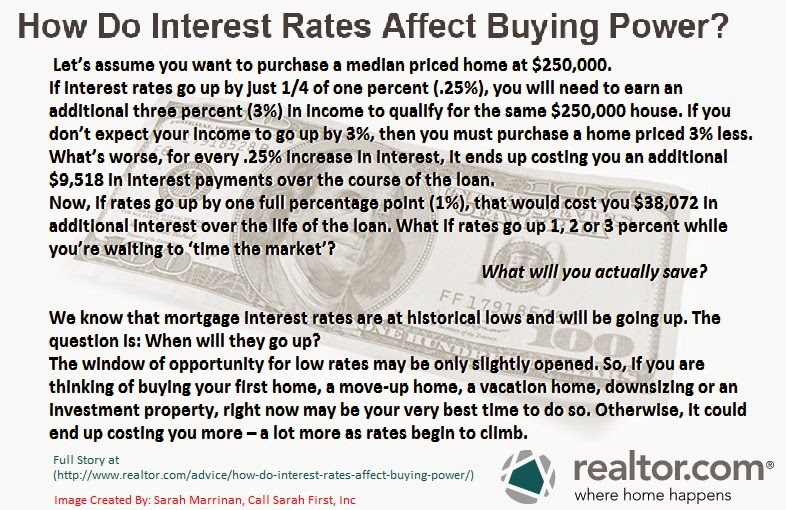
When interest rates are low, a buyer has the ability to purchase more home for their money than when interest rates are higher.

Home Prices
In addition to great interest rates, home prices are still low but they are rising! 

When you couple awesome low interest rates with an improving market, it's a great time to invest in a new home! 

*There is no crystal ball for the housing market.  We can't guarantee the results of an individual buyer or market area.  Please consult a real estate professional to find the best plan for you.


Low interest rates = more buying power!

Wednesday, May 8, 2013

Five Things You Must Know About the Current Housing Market

Even if you are not thinking about buying or selling real estate right now, it affects our economy so it's best you have an idea where things stand. 
by +Sarah Marrinan - Keller Williams Premier Realty 

Know this:

1) 2010 is recognized as the "bottom of the market" even though some areas continued to fall in 2011 and even 2012.  The recovery is patchy. Know your LOCAL market.

2) Lenders are cautious. Lending standard are overly strict and underwriting standards are tight making it hard for those with "less than perfect credit" to obtain a mortgage. Plus, banks own land that was foreclosed on and they are not eager to sell it for a loss. (The same can often be said for foreclosed homes.)

3) Mortgage rates are at historic lows. Most loans are currently backed by a government housing agency. The feds are keep rates low and this won't go on forever.

4) Real Estate flippers and investors are "at risk" if mortgage rates jump.  The higher the interest rates, the less people can afford to pay for housing.

5) Foreign buyers. Say what? Yes, foreign investors taking interest in U.S real estate shows faith in our market recovery but this is also helping to drive prices up for Americans.

What does this mean if you are thinking about buying or selling?
Buyers: You can afford more now while prices are still relatively low and interest rates are unbelievably low.
Sellers: If your market is recovering, you have better negotiating power AND the likely hood of your home selling is high!

Caution on both sides of the deal: Appraisals.  This is not just limiting in price but also condition. (See #2.)

Want to talk about it? Call me!


sources:
 http://www.usnews.com/news/blogs/rick-newman/2013/05/03/5-reasons-the-housing-recovery-remains-wobbly
 http://realtormag.realtor.org/daily-news/2012/09/17/analysis-blames-slow-recovery-tight-credit-market

disclaimer: I am not a financial consultant, tax attorney, etc.  Please seek those professional services if you need them.

Wednesday, May 1, 2013

Tips for buying NEW construction homes

Five things you should consider when choosing new construction over an existing home.

Unless you have an individual lot and hired a custom builder that will build-to-suit on your lot, most new homes are built in developments with a collective style. These developments can be as small as a cul-de-sac, or as massive as a former farm field filled with acres of new roads and new homes.
Often new construction homes are more expensive than resale homes of a similar size. They are built to the latest codes and standards, they tend to be contemporary styled and energy efficient. Sometimes, these types of developments can represent a savings over established developments with existing homes.
Either way, the decision between a new development and an established community is worth taking time to consider.

Here are some ways to make sure the new house you're buying is really the house you want:

  • Check the builder's track record. What else has the company built? Were previous projects completed on time, on budget and without bad blood between the builder and buyers?
  • Walk the streets. If you live nearby and previous stages of the development are occupied, ask the residents if the builder did quality work and lived up to contractual commitments.
  • Picture your home, not the model home. You can certainly have the granite counters, surround-sound home theater and jetted tub you saw in the model home, but they're not included in the base price. You will pay extra for them.
  • Bring your own agent. If the builder has a real estate agent on site, the agent will be more than happy to help you. But, on-site agents work for the builders who hire them. Their best interests will be for the builder, not you.
  • Finally, consider the intangibles. Similarly styled homes attract like-minded buyers, and most developments are built with families in mind however other communities may be designed for retirement. Depending on your point of view, the consistency, conformity and neighbors can be a blessing or a curse.
Start your search for a new home here: www.CallSarahFirst.com

Ready to get more information about building a new home? Try these resources:
Articles about Building a New Home
Interview and Find the Right Agent to Help you with New Construction
Choosing between Production Builders and Custom Builders


Friday, January 4, 2013

The Seller's Real Estate Catch 22


How To Avoid Getting Stuck with TWO Homes...or none at all.

The Problem
We’ve all heard the old saying about being caught between a rock and a hard place.  Well, unfortunately, that’s where most homeowners find themselves when they decide to move from one home to another.

The Real Estate Catch 22
You see, if you buy before selling, you could run the risk of owning two homes.  Or, just as bad, if you sell first, you could end up homeless. That’s what is known as the Real Estate Catch 22, and for thousands of homeowners, it’s an extremely stressful position they find themselves in.

How to Avoid the Real Estate Catch 22
This financial and emotional tightrope is one many homeowners feel they have to walk alone.  However, you should seek out agents offering specialized programs that can eliminate the stress and worry associated with selling and buying another home.

THE DILEMMA
The biggest dilemma when considering purchasing another home is deciding whether to buy first or sell first.  Either way is risky because you could end up owning two homes or no home at all. Let’s face it, the real estate market has become a tough environment for buyers and sellers alike. The fact is that it’s more difficult to get homes sold today and therefore it’s essential that real estate agents look for new and innovative ways to meet the demands of the market.

THE SOLUTION
A new and innovative program that some agents offer actually guarantees the sale of your home and takes away all of the worry and stress associated with selling and buying another home...

Want the details? Call me now for a Free, No Obligation Home Evaluation!

Sellers: Read about 8 Steps to Success or Search for Your New Home


Before starting the house hunt, sell my house, should I buy a house now?, should I wait to sell my house?, tips for selling your house

Thursday, December 20, 2012

Is now a good time to buy a house?

Though no economists agree completely, the general consensus is ABSOLUTELY buy a house now if you can afford one.

 This week in an article from CNN Money:
"Barclays Capital put out a report recently forecasting that home prices, which fell by more than a third after the housing bubble burst in 2007, could be back to peak levels as soon as 2015.
"In our view, the housing market had undergone a dramatic over-correction during the prior five years, resulting in pent-up demand for housing purchases that would spark a rapid rise in housing starts," said Stephen Kim, an analyst with Barclays, in a note to clients.
In addition to what Kim sees as a big rebound in building, he's bullish on home prices, expecting rises of 5% to 7.5% a year."

Now, 7.5% for 3 years won't get the market value all the way back up to what we paid for our house in 2005 by the year 2015 but it would be close.

So if you are a first time home buyer, grab onto to a record low interest rate and rush to your favorite agent!

If you need to sell your house to buy another one and you would like to wait for a bit of recovery, just remember, it won't just be your house increasing.  You can afford much more house now than you will be able to in 3 years and these interest rates can't last forever!

Sarah Marrinan
Realtor®
The Goerss Home Team - Keller Williams Premier Realty
www.CallSarahFirst.com
Direct: 651-964-0289


Thursday, June 14, 2012

Are you qualified to buy that house?


Get pre-approved for a mortgage in the Twin Cities
Did you know most sellers will only entertain offers that are accompanied by a pre-qualification or pre-approval letter from a lender (or proof of funds)?  Many sellers also require that buyers be pre-qualified before even booking a showing for their home.

Have you found a lender yet to get pre-qualified? If not, send me a message or give me a call and I can refer a couple.


Call Sarah! 651-964-0289
Facebook.com/CallSarahFirst

Are you ready to buy or sell?  Need help determining if you are ready?  I can help!
www.CallSarahFirst.com