Showing posts with label should I buy a house now?. Show all posts

Monday, October 27, 2014

Should You Use Your 401k to Buy A Home in the Twin Cities?

Is Your 401k  Better Spent on a Home?

Many people look at their 401k and they imagine all the things they could be doing now with that retirement money.  Using use this money for all the mounding credit card debt, school loans or even a home down payment often feels like the answer to life's immediate problems. But is it?

When it comes to home ownership, a 401k loan to help you achieve a 20% down payment could be to your benefit if you can afford to pay back both the loan and the new mortgage because it will help you avoid costly mortgage insurance.  It could also help you with closing costs so that you are not cashing out your entire savings right before you take on the potential hidden expenses of a new home.

In Short, The Math Always Wins.

A younger worker who has made a lot on stock funds in their 401(k) in recent years might want to temporarily tap that money to establish themselves as a homeowner.  Or, some workers closer to retirement might find themselves retirement-plan heavy with their eyes on a retirement home. To buy it, they might have to sell investments and eat a sizeable capital gains tax.

Read More: FINANCES | HOME BUYING TIPS |

PLEASE SEEK APPROPRIATE ACCOUNTING AND LEGAL ADVICE BEFORE MAKING YOUR DECISIONS. Make sure you understand the rules and risks before tapping your retirement savings to pay for a home.


Sources: 
http://www.msn.com/en-us/money/home-loans/should-you-tap-your-401-k-to-buy-a-house/ar-BB6Qmcl
http://www.kiplinger.com/article/real-estate/T010-C001-S001-borrowing-from-a-401-k-to-make-a-down-payment.html

Monday, April 7, 2014

How Do You Get the LOWEST Mortgage Interest Rate?

What is the  SINGLE BEST WAY to get the LOWEST INTEREST RATES on your MONTHLY MORTGAGE PAYMENT?

Although it may seem obvious,  many people do not know that their credit score will dictate their monthly mortgage payment. The lower the score, the higher the payment.

Bad credit can cost you thousands, if not hundreds of thousands of dollars over the lifetime of your loan. Do not wait until you are trying to get qualified to take care of this vital piece of information, as it may be too late by that time to do anything about it.

Contrary to many beliefs you CAN raise your credit score in as little as 60 days. 

Many lenders have suggestions and programs. CONTACT ME for a list of lenders that may be able to help you get on track!


More Topics That May Interest You:

Search for Homes  |  Get A Mortgage  |  What is Your Home Worth?  |  Home Buying Help  |  Increase Your Appraised Home Value


Tuesday, February 18, 2014

Why You Might THINK TWICE about Choosing a New Construction Home

Five reasons you may hesitate to buy a new build home

Like most of the real estate industry, there’s been major growth in new home construction. Here are five reasons to think twice before choosing to build a brand new home.

  • Logistics
    • Can you get the move coordinated? If you already have another home, do you have a place to go if yours sells before the new home is complete? Do you qualify for the new home without selling your current home?
  • Limited negotiating room on price
    • The advertised price is based on certain features - usually the entry level pricing but what you see in the model is usually all the upgrades.  Many buyers that choose new construction experience a bit of heartbreak when they have to settle for less than what they saw in the model or realize there are features they want but can't afford.  
  • Headaches
    • Are you ready for all the builder meetings and decisions that come with planning and building a new home? These meetings often require weekday appointments. What if there are unforeseen changes or delays?
  • Cookie-cutter design. 
    • Frequently less character, or homogenous design. Often you will pick a from the same selection of model designs that your neighbor chose from but in slightly different color combinations.
  • Potential for homeowners association dues. 
    • Frequently, new neighborhoods have a homeowners association or covenants that can put limits on how you use your property and may include dues.


What some great reasons to buy new?  Watch for an article in the next week! Five Reasons you SHOULD build a new home!

More Tips for buying NEW construction homes.

Friday, January 10, 2014

BUYERS MUST KNOW: Eight Things Your Mortgage Lender Evaluates

During the years preceding the mortgage crisis, too many mortgages were made to consumers without regard to the consumer’s ability to repay the loans.

The “ability to repay” rule, effective January 10th, 2014, requires lenders to take into account the following minimum underwriting factors:
  1. current or reasonably expected income or assets; 
  2. current employment status; 
  3. the monthly payment on the covered transaction; 
  4. the monthly payment on any simultaneous loan; 
  5. the monthly payment for mortgage-related obligations; 
  6. current debt obligations, alimony, and child support; 
  7. the monthly debt-to-income ratio or residual income; and 
  8. credit history.
              Plus, in 2014, lenders will also be aiming to increase the number of loans considered “qualified mortgages.” While not all lenders plan on sticking to qualified mortgages, most will in order to avoid the liability challenges inherent in riskier loans. Here are three things that they will be going for:

              1. A mortgage that keeps the borrower’s debt below 43 percent of monthly income unless it’s government backed (Fannie, Freddie or the FHA).
              2. Clean loans. Loans free of extended terms, interest-only payments and loans that don’t meet the full amount of interest.
              3. Loans above $100,000 with less than 3 percent in upfront points and fees.


              Need help finding a lender that will help you navigate your options under the new underwriting rules?  Please contact me and I will make sure you are in good hands!


              TAGS: The Dodd-Frank Act, Ability to Repay, Mortgage Underwriting Standards

              See Also:  MORTGAGE  |  FINANCES  |  HOME BUYING TIPS  |


              Connect with me and get more great content!


              Monday, December 2, 2013

              How To Save Money for Buying a Home


              Unfortunately the down payment remains among the greatest obstacles to buying a home, so start planning for it... Along with closing costs, moving expenses, insurance and incidentals. 

              The larger down payment remains the industry-underwriting staple. Lenders prefer to loan money to borrowers who share as much of the risk as possible. A larger down payment generally means better interest rates and less (or zero) mortgage insurance. Mortgage insurance is money you'll never get back...

              Here are a few ways to save more money, faster.
              • Stop impulsive and compulsive spending habits. Skip the fancy drive-thru coffee and use a coffee maker at home. 
              • Cancel subscriptions to magazines, the gym (get a friend and a video and do it at home), reduce your cable television channels and cut back on other services you can buy for less.
              • Stream movies or grab a Red Box and microwave your popcorn at home or have a game night at home instead of going out every Friday night.
              • Bag your lunch, go generic at the supermarket, reduce data gigabytes from 10 to 5 on your smart phone and wait until you have with-fi to Tweet and share.
              • Plan to save. You won't know where you can cut costs if you don't know where your money goes. Make a budget to track your income and your expenditures.
              • Auto-Save. Transfer that money directly from your paycheck into a savings or other interest bearing account using an automatic program at your bank or credit union.
              • Bonus: The more you save, the more options you'll have to diversify savings into investments for a better return on your money.
              • Dump credit accounts. Stop the "emergencies only credit card" nonsense. If you are saving money, there's your emergency fund. Any kind of credit allows you to spend more than you have and then pay through the nose for high credit card interest rates.
              • Liquidate valuable hobby assets. What's more important? Buying a home or hockey gear? Something's got to give.
              • De-clutter your garage, attic and closets. Gain a little cash plus when you move, you'll have less stuff to move and a smaller mortgage to boot.
              • Get a(nother) job. A second job, maybe even a third. Finding additional sources of income can really help speed up that home buy.   Seasonal work, a home-based business, working half a night shift. If you're working you're not as likely to be spending. 
              • Stop loaning money to the federal government. A tax rebate is nothing more than a loan to Uncle Sam, until tax return filing time, but you get zero interest. Adjust your W-4 to match your true tax liability and save the difference.

              Sarah Marrinan - Keller Williams - www.CallSarahFirst.com


              See Also: Home Buying Tips  |  Homes for Sale  

              Thursday, November 7, 2013

              Smart Homebuyers Are Locking In Ultra Low Rates Before The Fed Hike

              Are you a smart home buyer?
              By +Sarah Marrinan - Keller Williams Premier Realty 
              The recent mini spike in mortgage rates has homeowners scrambling to save thousands over the next several years by locking in a rate today. Many homeowners are just now recuperating from seeing their home values plummet in the past, to finally seeing positive equity, so now is the time to take advantage of low-rate mortgages before rates begin climbing higher.
              The Fed lowered short term rates several years ago to near zero in an effort to revive the economy. Now that we are seeing a recovery it's expected we will begin to see rates escalate to normal levels. Historically, rates on 30 year loans are usually between 5.50%-7.25% and higher. Below is the difference on a $200,000 mortgage for a 30 year term at an available rate today of 3.25% vs 6.75%.
               Search for homes now!

              Sunday, September 29, 2013

              What is more important? Credit Score or Down Payment?

              So, is your credit score more important or the size of your down payment when it comes to getting a mortgage on a house?  

              Let's take a look. You down payment determines your Loan to Value ratio.  Your LTV and credit score are primary factors in determining your mortgage qualification and the rate your will receive.

              To demonstrate how Loan To Value and credit score impact APR, consider these three buyer profile scenarios.
              • Jenny has managed to save up a sizable down payment of 30% on her dream home, but she has always paid for everything in cash and has no credit history so her credit score is only 635.  
              • Amy has a good credit score at 745, but she only has enough for a 5% down payment.  
              • John also has a credit score of 745 but has saved enough to put 20% down. 

              Despite their very different profiles, Jenny and Amy would get nearly the same APR (4.98%) on their mortgage, indicating they pose equal risk to the mortgage underwriters. John, however, would get the best rate, nearly 60 basis points lower at 4.41%.
              Assuming they have all have $1,000 per month for their monthly mortgage payment, Jenny would be able afford a house of $265,000; John a house of $250,000; and Amy a house of $195,000.

              Want to see what your specific situation qualifies for? Contact Paul Johnston today!

              Already qualified and ready to buy?  I'm here for ya' as always!


              Wednesday, June 12, 2013

              Do I have Buying Power?

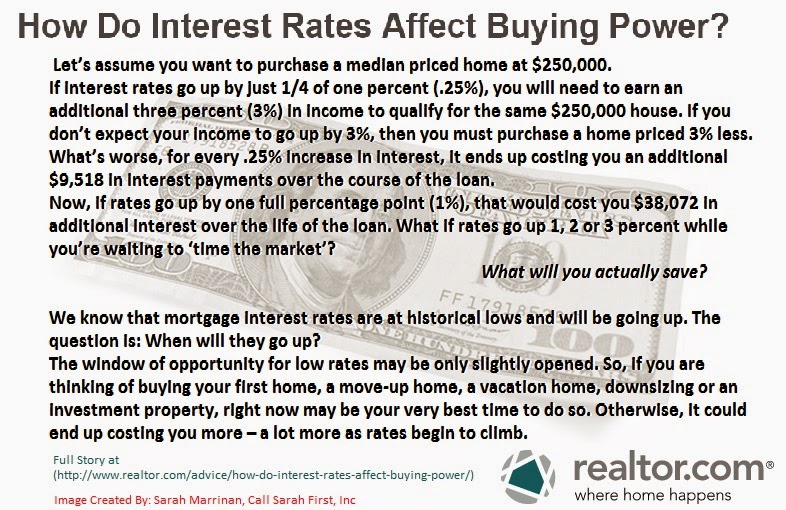
              You may have probably heard the term "buying power" floating around in today's housing market. Buying power, also called purchasing power, is the value of money, as measured by the quantity and quality of products (and services) it can buy.
              
              Buying power helps you get more house for your money!
              Buying Power!
              In real estate, this term is primarily based on a couple things, interest rates and home prices; getting more home for your money.

              Current Interest Rates
              When interest rates are low, a buyer has the ability to purchase more home for their money than when interest rates are higher.

              Home Prices
              In addition to great interest rates, home prices are still low but they are rising! 

              When you couple awesome low interest rates with an improving market, it's a great time to invest in a new home! 

              *There is no crystal ball for the housing market.  We can't guarantee the results of an individual buyer or market area.  Please consult a real estate professional to find the best plan for you.


              Low interest rates = more buying power!

              Wednesday, May 8, 2013

              Five Things You Must Know About the Current Housing Market

              Even if you are not thinking about buying or selling real estate right now, it affects our economy so it's best you have an idea where things stand. 
              by +Sarah Marrinan - Keller Williams Premier Realty 

              Know this:

              1) 2010 is recognized as the "bottom of the market" even though some areas continued to fall in 2011 and even 2012.  The recovery is patchy. Know your LOCAL market.

              2) Lenders are cautious. Lending standard are overly strict and underwriting standards are tight making it hard for those with "less than perfect credit" to obtain a mortgage. Plus, banks own land that was foreclosed on and they are not eager to sell it for a loss. (The same can often be said for foreclosed homes.)

              3) Mortgage rates are at historic lows. Most loans are currently backed by a government housing agency. The feds are keep rates low and this won't go on forever.

              4) Real Estate flippers and investors are "at risk" if mortgage rates jump.  The higher the interest rates, the less people can afford to pay for housing.

              5) Foreign buyers. Say what? Yes, foreign investors taking interest in U.S real estate shows faith in our market recovery but this is also helping to drive prices up for Americans.

              What does this mean if you are thinking about buying or selling?
              Buyers: You can afford more now while prices are still relatively low and interest rates are unbelievably low.
              Sellers: If your market is recovering, you have better negotiating power AND the likely hood of your home selling is high!

              Caution on both sides of the deal: Appraisals.  This is not just limiting in price but also condition. (See #2.)

              Want to talk about it? Call me!


              sources:
               http://www.usnews.com/news/blogs/rick-newman/2013/05/03/5-reasons-the-housing-recovery-remains-wobbly
               http://realtormag.realtor.org/daily-news/2012/09/17/analysis-blames-slow-recovery-tight-credit-market

              disclaimer: I am not a financial consultant, tax attorney, etc.  Please seek those professional services if you need them.

              Tuesday, April 23, 2013

              How do I know if I am ready to buy or sell a house?

              Getting your money matters in line before buying and selling real estate will help ensure the process is less stressful and you make the best decision for your current situation and your future.
              Two comon real estate regrets for buyers are:
              • they wish they had put down a larger down payment on their home, and
              • they wish they had been more financially secure before they bought a home. 
              So how does this apply in terms of financial preparations for home buying? Do more than the bare minimum to qualify for the sort of home you want when it comes to saving up the minimum down payment for your desired purchase price, getting credit boosted as much as possible and making sure we have all documents lined up for a lender’s underwriter. 

              View home buying as an opportunity to take a deeper look into your finances and make an ongoing, lifelong commitment to good financial pricipals and planning.
              This means:
              • keeping a current budget and creating a financial plan that includes not just your mortgage and other living expenses but also carves out sufficient resources for saving, investing and other things that represent your values and are important to your future, and
              • staying accountable to these values and your plans, even through the process of becoming a homeowner.
              So how does this apply in terms of financial preparations for home selling? Know the expenses involved in selling when it comes to fees, taxes, home repairs, moving, etc. and what your bottom line is financially.

              If you are considering selling you home, it's a good time to evaluate:
              • what items are in need of immediate repair/updates?
              • what do you like and dislike about your home?
              • why do you want to move?
              • how is the market in the area where I am living now vs where I want to be?
              • where will you live when if home sells?
              • what happens if you don't move in the next 1 year? 5 years?

              There are many books, resources and financial professionals who can help you ensure that you execute home ownership in a way that is ultimately beneficial to your financial well-being and not harmful to it.  This includes timing your real estate transaction to align with when you’ve achieved certain financial goals (savings, reduced debit, credit improvement, etc) or have cultivated particular financial habits (follow a budget, goal setting, etc). 

              Once you have a financial picture and are ready to make a move, it's time to find a real estate agent that will help you get access to the best values and negotiate the best terms and/or get your home sold for the most money, in your desired time frame and hopefully with the fewest amount of headaches possible. 

              Buying and selling real estate is a process and for most people, the largest financial decision they will make in their lifetime. Seeking professional advice and assistance will help you navigate through.
               

              Saturday, February 23, 2013

              A Buyer's Emotional Rollercoaster

              Buying a home is tied to a lot of emotion.  
              It's always tied to a life change and change can be extraordinarily stressful for some people and exhilarating for others so it's only natural to go through a range of emotion when looking for that perfect home.

              As with many big milestones in life, home buying is initially more of an emotional commitment than it is a financial one. Sure, you're saving up thousands of dollars to fund the down payment and yes you will be paying hundreds of thousands of dollars in monthly payments which makes it sound like primarily a financial decision. But the bottom line is that most home buyers purchase first from their emotions, and then justify the purchase with their wallets. You may have set of criteria but then just by chance you see a house (or condo or farm) and your heart skips a beat! It LOOKS PERFECT! But then, you realize it doesn't meet some of your criteria... and you still buy it!

              Are you ready to buy a house?
              Are you ready to buy a house?
              How do you keep your emotions at bay in the heat of the process (as much as possible anyway) so that you will be satisfied with your emotional choice?  The best answer is to do some research and have a plan.

              Know how much you need to have for downpayment and moving expenses. Talk to a lender about your financing options, downpayment and closing expenses. Ask a real estate agent to help you make a list of potential moving expenses. Get a pre-approval letter if you will be financing your purchase.  Have a your current financial statement available for proof of funds if you are buying on cash.

              Think about your motivation for the move. Where are you moving to?  Why that location?

              Decide on your time frame.  When do you want things to happen?  What if your house doesn't sell? What if your house sells too fast? Moving can take months of planning!

              Understand the challenges in the current market.  It's easy to be let down when you can't find a house in the time frame you would like or can't get the house you want in your price range... but it happens.

              Get prepared to move.  Pack and clean your current home. *Do NOT pack away your tax records and financial information. You will likely need this info for the mortgage company.

              Hit the internet, scour the phone book, ask your family and friends or check with your agent; however you choose to do it, get help. Research neighborhoods, schools and anything else important to you.

              Build a team. Inspectors, handymen, cleaning companies may be an added expense but they will come in handy and it's always less stressful when a professional does it than trying to get everything done yourself.

              If you have done your research, you might make an offer on one of the first houses you actually go out to see!  You will know what is out there in your price range and it when that "one" comes up, you will jump on it!

              There will always be hiccups along the road but if you have spent time weighing your options and preparing, you can tackle them!

              Need help getting through this? Call me!


              Friday, December 21, 2012

              More than 50% of the way to housing recovery!

              This just in from the Trulia blog!


              Halfway Home: Housing Recovery Crosses 50%

              Jed Kolko, Chief Economist, December 21, 2012


              Each month, Trulia’s Housing Barometer charts how quickly the housing market is moving back to “normal.”  They summarize three key housing market indicators: construction starts (Census), existing home sales (NAR), and the delinquency-plus-foreclosure rate (LPS First Look). For each indicator, They compare this month’s data to (1) how bad the numbers got at their worst and (2) their pre-bubble “normal” levels.

              In November 2012, home sales saw strong increases, and the delinquency + foreclosure rate held steady–both signs of market improvement. However, new construction starts declined.

              Hurricane Sandy appears to have lowered construction (and sales, to a lesser extent) in the Northeast. Average monthly construction starts were 14% higher nationally in October and November – the months affected by Sandy – than in the previous four months, but 5% lower in the Northeast. Average monthly home sales were 7% higher nationally in October and November than in the previous four months, but just 3% higher in the Northeast.


              • Construction starts dipped in November but remain strong. Starts in November were at an 861,000 annualized rate, down 3% month-over-month and up 22% year-over-year. For the past three months, construction starts have remained solidly above 800,000–the highest level since September 2008. Nationally, construction starts are 37% of the way back to normal.
              • Existing home sales rose once again in November. After climbing in October, existing home sales rose 6% month-over-month to 5.04 million in November–the highest level since November 2009. Sales are 73% back to normal. Even better, “distressed” sales (foreclosures and short sales) represent a declining share of overall sales, making way for more “conventional” home sales.
              • The delinquency + foreclosure rate maintained a new post-crisis low. In November, 10.63% of mortgages were delinquent or in foreclosure, down a hair from 10.64% in October. The combined delinquency + foreclosure rate is at its lowest level in four years and is 41% back to normal.


              Averaging these three back-to-normal percentages together, the housing market is now 51% of the way back to normal, compared with 28% in November 2011. Trulia’s Housing Barometer has jumped five points in each of the last two months. Does halfway back to normal mean the glass is half-full or half-empty? The half-empty view is that our three housing measures hit bottom (on average) in 2009, so it’s taken the market a long time–three years–to get to the halfway mark. But the half-full view is that halfway back to normal is better than anyone –myself included–predicted for 2012 at the start of this year.


              Contact me for help with all your real estate buying and selling needs! 

              Thursday, December 20, 2012

              Is now a good time to buy a house?

              Though no economists agree completely, the general consensus is ABSOLUTELY buy a house now if you can afford one.

               This week in an article from CNN Money:
              "Barclays Capital put out a report recently forecasting that home prices, which fell by more than a third after the housing bubble burst in 2007, could be back to peak levels as soon as 2015.
              "In our view, the housing market had undergone a dramatic over-correction during the prior five years, resulting in pent-up demand for housing purchases that would spark a rapid rise in housing starts," said Stephen Kim, an analyst with Barclays, in a note to clients.
              In addition to what Kim sees as a big rebound in building, he's bullish on home prices, expecting rises of 5% to 7.5% a year."

              Now, 7.5% for 3 years won't get the market value all the way back up to what we paid for our house in 2005 by the year 2015 but it would be close.

              So if you are a first time home buyer, grab onto to a record low interest rate and rush to your favorite agent!

              If you need to sell your house to buy another one and you would like to wait for a bit of recovery, just remember, it won't just be your house increasing.  You can afford much more house now than you will be able to in 3 years and these interest rates can't last forever!

              Sarah Marrinan
              Realtor®
              The Goerss Home Team - Keller Williams Premier Realty
              www.CallSarahFirst.com
              Direct: 651-964-0289


              Wednesday, June 20, 2012

              Do This, Don't Do That

              When it comes to buying a house, a list of do's and don'ts can help you get off on the right foot especially if you plan to apply for a mortgage.  Here are some basic dos and don'ts to help you stay on track with your home ownership plans.

              Do This

              ● Do Pay Old Debts – The less debt you have, the easier it’s going to be to get a great mortgage. Paying down your debt as this is another area that a lender will look at if you don’t have a lot of capital to put down as collateral.
              ● Do Pay Off Early – If possible, don't ever make minimum payments. Adding a little extra every month to debt payments is a really good help when trying to get a mortgage in the future. This applies to existing mortgages as well. The quicker you can pay it off, the better.
              ● Do Show Evidence of Down Payment Savings – Though some loans will allow you to receive "gift funds" from a family member for your down payment, it is best to show you have acculated your own down-payment savings

              Don't Do That

              ● Don’t Miss Payments – If you currently have a mortgage or any other type of loan, make sure you always make the payments on time. Car payments, credit card payments, school loan payments... it doesn't matter what type of loan it is, you need to pay on time every time.
              ● Don’t Overextend – Many people like to live beyond their means – i.e. spend more than they make – but this can quickly lead to problems. When getting ready to apply for a mortgage, make a household budget and practice sticking to it for six months before you apply. Use a "cash-only" system so you are not buying anything on credit.   By not overextending yourself financially, you can increase your chances of mortgage approval.

              Want more mortgage advice?  I have have a handful of trusted mortgage professionals that would be happy to discuss your options and create a plan to get you the best possible loan terms for your situation.  Contact me now!

              Monday, March 7, 2011

              Single buyers: Know this!

              Single Homeownership is Awesome ... If You Consider This...

              When I bought my first home, I was a single female.  I was living in an apartment with a friend. I had a car and had a career.  I had no pets.  I could do what I wanted to do when I wanted to do it. One day, someone said to me, "what's next; marriage or a house?" and they chuckled.  But that got me thinking.

              I'm not anywhere near getting married so I guess I should look into buying a house.  But where do I start?

              So I talked to an agent, who referred me to a lender and I'll leave the rest of the story for another time but what I want to go back to for this story were things I kinda figured out along the way instead of in advance.

              Show me the money!

              The first thing you should ask yourself is how much have you saved up for a downpayment and closing costs to purchase a home. 5%? 10%? 20%? This affects your purchasing power so it's the first consideration.

              Credit? Debit?

              These things affect your ability to get a loan.  In many cases, you can improve your credit score in just 3-6 months with help... all while saving up more down payment for buying your home. :)

              Financially feasible.

              Work backwards from your existing monthly budget, not the amount of the loan you are approved for with the lender.
              Once you know your comfortable mortgage payments plus monthly expense budget ask yourself these questions:
              1) If I lose a job, have a health issue, or anything else happens that could affect your ability to cover your monthly mortgage and other costs, do I have savings or a back up plan to make the payments?
              2) Am I willing to have a roommate?

              I am a grown up.

              Once you have thought out the financials, now you can think about the responsibilities of owning a home.
              Who's gonna mow the grass? Plow the snow? Who's responsible for maintenance? Do you even own a shovel or a screwdriver? If you cringe when you hear these things, you may want to consider a home in an association like a townhouse or condo.  Don't buy a home you can't manage yourself.

              Location, location, location.

              Look out for your safety and security. Consider proximity to work, friends and family. What neighborhoods can you afford? How is the lighting at night? Is the parking attached? Is the bedroom on ground floor?  What concerns you?

              Resale?

              OK, so how single are you?  Is this a property you would keep long term or need to sell if your relationship status changed?  Are you in your job for the long haul or could you be relocated in a year?
              Purchasing a home is generally a great long-term investment but if there is a chance it's not long term, make sure to only consider homes that have great general appeal and will be easy to resell (or rent) if need be.

              You got all that? EXCELLENT!
              Still need more guidance? NO PROBLEM!

              I can help you either way. :-) 

              If your friends are like mine were, they are going to envy your financial responsibility.  Your savvy investment in a home and paying your own mortgage instead of someone else's is going to have your family impressed!  Aren't you excited about saying "want to come to my house?" and knowing it's YOURS! 

              You might be interested in:
              Search for Your First Home